By Fearghal Reid
3 1/2 Minute Read
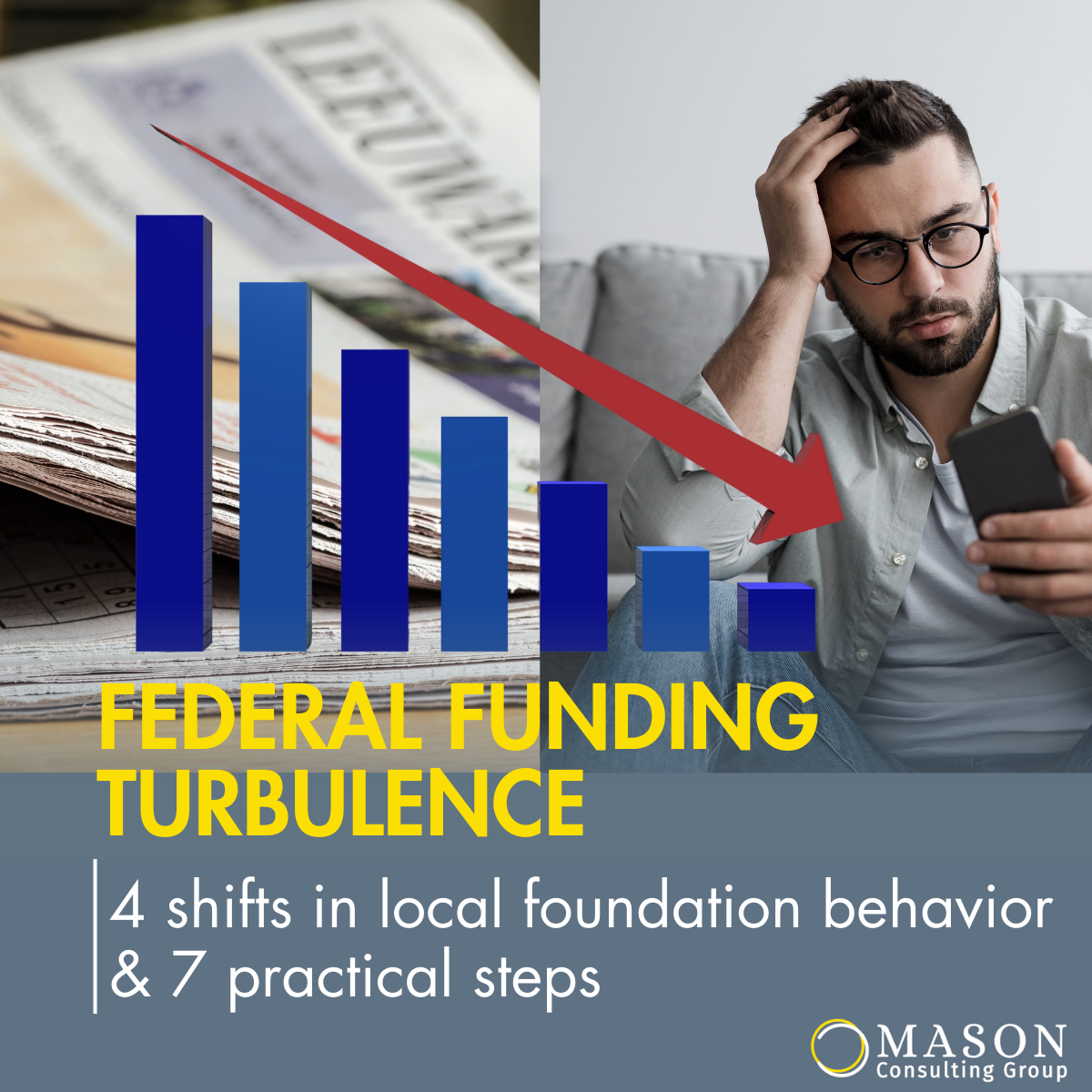
In Part One, we explored how turbulence in federal funding is reshaping the rules for competitive grants. The impact doesn’t stop there. Federal volatility is now putting pressure on local foundations — and it’s showing up in the way they make funding decisions.
Some foundations are being asked to fund more nonprofits with roughly the same resources. By law, private foundations must distribute about 5% of their assets each year, so strong investment years can temporarily increase their grantmaking budgets. But even at their best, foundation dollars can’t replace the scale or consistency of federal funding, especially in sectors like medical research, education, arts, infrastructure, or workforce development. Federal programs are designed to operate and scale at a level that local and private giving simply cannot replicate.
While overall giving totals in Ohio rose slightly last year compared to the year before, when adjusted for overall trends, growth stayed within typical margins — even as application numbers surged¹. This mirrors national patterns: Candid’s Foundation Giving Trends survey found that many funders are responding to higher demand by making smaller awards to a larger pool of grantees².
Locally, competition for foundation dollars is more intense than ever. Foundation officers funder panels, and peer groups consistently report that many funders are now receiving exponentially more requests — in some cases up to nine times previous cycle totals. This isn’t a short-term spike; it signals a fundamental shift in the funding climate, where even strong proposals must rise above unprecedented volume.
For small and mid-sized organizations, the risks are sharper. Research shows that funding concentration is common at every scale: over 90% of large U.S. nonprofits (those with $50 million or more in annual revenue) depend on one dominant funding category for most of their budget³, and many small to mid-sized organizations rely on fewer than three core funders⁴ – a structure that leaves them highly vulnerable to shifts in priorities or reductions in support. In practical terms, the loss or reduction of a single funder can jeopardize programs and staffing almost immediately. Without diversified support, stability rests on a narrow, fragile base.
The New Local Reality
Analysis points to four major accelerating shifts in local foundation behavior:
- Doing more with the same resources — Many local foundations are working with giving levels that are stable compared to recent years, but the number of requests has grown dramatically. As a result, the same pool of funds is spread across more organizations, with average grant sizes decreasing.
- Prioritizing existing relationships — In the face of record demand, many funders give preference to organizations they have funded in the past or that are closely connected to their leadership or mission priorities. New applicants must work harder to break through this preference pattern.
- Focusing tightly on mission alignment and readiness — Review panels are scrutinizing whether applicants can clearly articulate their purpose, document the need, and demonstrate the operational capacity to deliver results. Strong alignment between the applicant’s work and the funder’s stated goals is a must.
- Expecting stronger stewardship — Funders increasingly value grantees who keep them informed between formal reports. Short, meaningful updates, event invitations, and transparency about challenges are now part of the relationship expectation.
What Nonprofits Need to Do Now
- Diversify Your Foundation Portfolio
Relying on the same funders year after year is risky. Map your current funding sources, calculate each as a share of total foundation income, and aim to keep any single funder at no more than 20–25%. Small Ohio nonprofits dependent on fewer than three funders face much higher risk when priorities shift⁴. - Strengthen Funder Relationships
Like all giving, Grant funding is as much about trust as it is about need. Schedule regular touchpoints where appropriate, invite program officers to site visits, and share updates tied directly to their priorities. Organizations with consistent, substantive engagement enjoy higher renewal rates⁵⁶. - Double Down on Mission Alignment
Focus on funders whose goals truly intersect with yours. Before applying, compare your mission to their stated priorities. If overlap is weak, move on. Strong alignment increases the odds of a long-term relationship because you’re already working to make the same impact. - Audit and Prepare Your Metrics Before the Cycle Starts
Examine what you do and how you measure success. Identify the key metrics, performance indicators, and logic models that demonstrate your impact. Have these materials ready before each funding cycle and update them at least halfway through the year so you can respond quickly to new opportunities or unexpected inquiries. - Refine Your Voice — and Back It Up With Metrics
Storytelling wins hearts, data wins minds. Maintain a library of client testimonials and case studies alongside an impact dashboard with key performance indicators (KPIs) such as number of clients served, measurable outcome changes, and cost per outcome. Always make the connection between your outputs and the funder’s intended impact explicit. - Track and Test Your Mix
Healthy funding is diversified funding. Cap any single source at no more than 25% of your total budget⁷. Model “what-if” scenarios — such as losing your top funder — and have a plan in place before a crisis forces the issue. - AI Is Not a Silver Bullet
AI can make drafting faster, but speed is not the same as competitiveness. Funders are increasingly attentive to authenticity, local detail, and clear, mission-linked outcomes⁸. If you use AI, treat it as a starting point only — then rewrite in your own voice, add specific local context, and tie every story to quantifiable results. In an oversaturated market, “template-feel” applications rarely survive first review. For more on AI and grant writing, check out our previous blog here.
Looking Ahead
Nonprofits that treat funding as a dynamic landscape — adjusting for shifting priorities, diversifying income sources, and deepening relationships — will be more resilient in uncertain times. Organizations that paired authentic storytelling with verifiable outcomes and clear KPIs weathered pandemic volatility far better than those dependent on a narrow base⁹.
Competition will remain fierce. But those combining operational discipline, genuine community voice, and solid performance metrics will be best positioned to stand out — and stand strong.
Footnotes
- Marietta Community Foundation – Fall 2024 Grant Awards
- Candid – Foundation Giving Trends 2024
- The Bridgespan Group – Concentration of Revenue in Large Nonprofits (2024)
- Urban Institute – Nonprofit Sector in Brief 2023
- Grantmakers for Effective Organizations (GEO) – Funder Practices Survey 2023
- Center for Effective Philanthropy (CEP) – Relationships Matter (2024)
- Nonprofit Finance Fund – State of the Nonprofit Sector Survey 2024
- Chronicle of Philanthropy – Funder Policies on AI-Generated Proposals (Apr 2025)
- Johns Hopkins Center for Civil Society Studies – Nonprofits in the COVID Economy (2022)